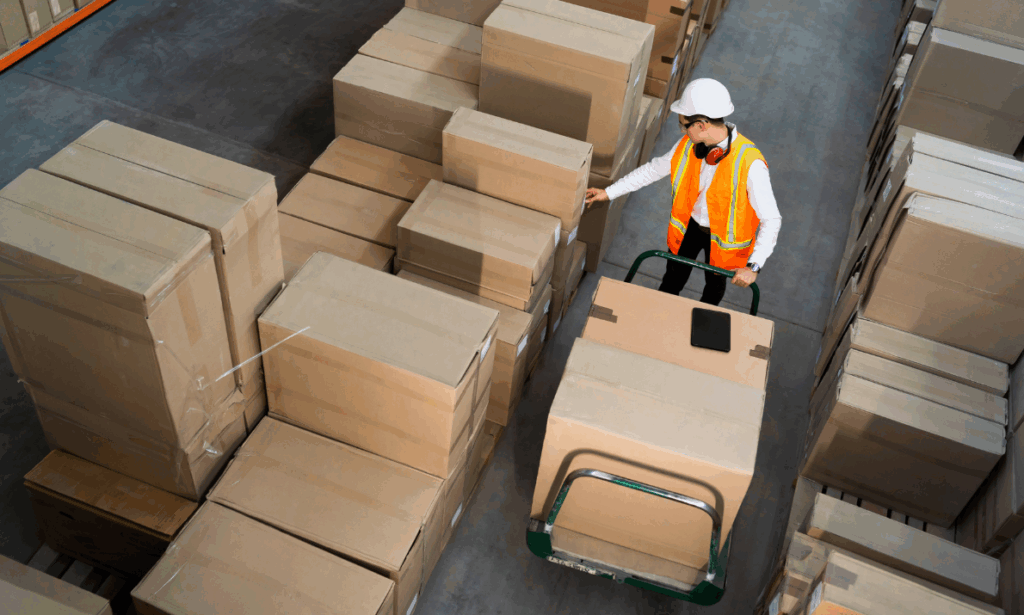
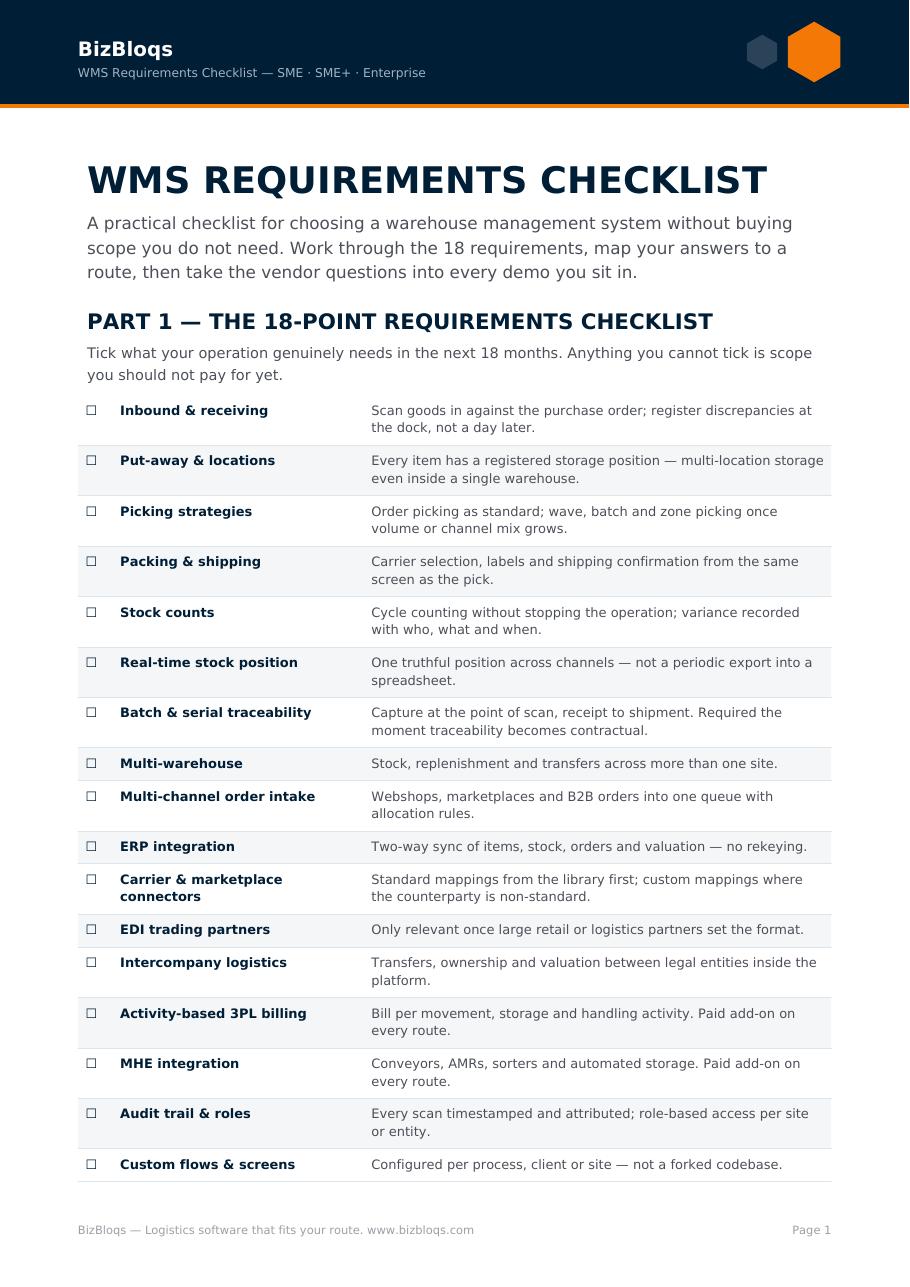
Warehouses struggle to find and keep staff. Seasonal peaks make it worse, and a new hire who needs weeks of shadowing is not much help when the peak is this week. Customers still expect fast and correct delivery. A warehouse management system does not create extra people, but it changes how much each person has to know, remember and correct. That is where most of the gain is.
Faster onboarding with guidance on the scanner
The traditional way to train a picker is to let them walk along with an experienced colleague. It takes that colleague off the work, and the new person still feels unsure when they are on their own.
With a WMS, the guidance moves to the handheld scanner:
- The screen shows the location, the item and the quantity.
- The picker scans the location and the item before moving on.
- A wrong scan is flagged straight away, so the correction happens at the shelf.
- Every task follows the same steps, whoever is on shift.
The new picker learns by doing the actual work, with the system checking each step. Nobody has to learn the layout of the warehouse by heart first. With BizBloqs, new staff are productive on the same day.
One standard process instead of many habits
When the process changes per shift or per supervisor, people get different instructions depending on who is in charge. That leads to uneven results and mistakes that nobody can quite explain.
A WMS removes that uncertainty by making everyone follow the same rules. Whether someone picks, puts away or counts, the system directs the work in the same way every time.
This matters more than it seems. In many warehouses, a lot of the real process lives in people's heads: the shortcuts, the exceptions, the "we always put that one there". That is called tribal knowledge. When the process is in the system instead, a new employee does not need months of watching to learn the real way of working. They follow the same prompts as everyone else, and the operation no longer depends on which experienced person happens to be in.
Teams that do not share a first language
Warehouse teams often come from many backgrounds, and peak capacity often comes from temporary or seasonal staff. An instruction someone cannot read properly is an error waiting to happen.
A good scanner workflow helps in three ways:
- Instructions appear in the worker's own language. BizBloqs scanner screens come in six languages: Dutch, German, English, French, Spanish and Chinese.
- Each screen asks for one thing at a time, so there is little text to read.
- The scan confirms the step, so a misunderstanding is caught at once rather than at the packing bench.
This makes it much easier to add people at a peak without a large training effort, while keeping accuracy where it should be.
More output from the same team
When headcount is limited, the work itself has to get lighter. Three things make the biggest difference.
Less walking. The scanner leads the picker through the locations in a set order, so nobody works out the route themselves or walks back for a forgotten line. That order is called the pick sequence. Picking several orders in one round saves even more walking; that is called batch picking.
Even workload. Releasing work in groups that the team can handle keeps pickers busy without flooding the aisles or the staging area. Releasing orders in planned groups is called wave picking. Replenishment triggers make sure the pick location is filled before a picker arrives at an empty shelf.
Less rework. Every wrong item that reaches a customer comes back as a return, a credit and a second shipment. A scan at the shelf stops most of those errors before they cost anyone time. For the detail, see error-proof picking and the methods on warehouse picking.
How many pickers a given volume really needs is a calculation, not a feeling. The warehouse labour calculator works it out from your order lines, the seconds per line and the productive hours per shift.
Supportive tools and staff turnover
People often leave a job when it feels chaotic: unclear tasks, constant corrections, priorities that change every hour. A WMS takes away much of that by giving clear, step-by-step guidance, so people always know what comes next and spend less of their day fixing someone else's mistake.
Clear records help as well. Every scan is stored in an audit trail, so a supervisor can see what happened instead of guessing, and coaching can be based on facts rather than on who is blamed. Good tools do not replace good leadership, fair planning and recognition, but they remove daily irritations that wear a team down.
Building a workforce plan that holds up
Hiring alone will not solve a labour shortage. The more lasting answer is to redesign the work so each person contributes more with less effort: remove unnecessary walking, let the system take over routine decisions, and keep the workload balanced across the shift. Visibility of open work makes it easier to move people to where a backlog is building, before it turns into a late truck.
The result is a team that works with more confidence because the process gives structure and support in every task, and new people who can join that process from their first shift.
How BizBloqs helps
BizBloqs warehouse management software comes in three tiers. Directed work is part of all three: guided picking, a set pick sequence and replenishment triggers.
- SME: guided scanner work with the standard process, for a warehouse that wants to move from paper to scanning. No modules at this tier.
- SME+: adds batch picking and wave picking, and flows and rules customised to your operation. Modules can be added at a charge, with configuration.
- Enterprise: all modules included; the configuration work is charged.
Scanner screens come in six languages, BizBloqs supports voice picking and pick-to-light, and every step is recorded in an audit trail with role-based access.
Before adding headcount, check your real picking rate with the warehouse calculators and compare it with what a WMS costs. If you would rather see it on your own process, book a demo.